For those who don’t know, Gartner group are a business/technology research outfit who produce reports on things technical and business related. They have a pretty good reputation and they have a couple of sidelines in consulting and event organizing (or is it the other way round?). Sometimes they are leading opinion and sometimes following. They sell their reports, their conferences are expensive and their consulting must be more so.
Anyway, the reason for saying this is that Gartner have decided “Pattern Based Strategy(tm)” is the next big thing: “Companies Must Implement a Pattern-Based Strategy to Increase Their Competitive Advantage.”
(Notice the “(tm)”. Somebody, somewhere owns the trademark “Pattern Based Strategy.” Hillside own the trademark “PLoP” but not “pattern”. Could the owner of this one be...?)
Now as many of my regular readers will know, I’ve been talking about Business Strategy Patterns for over five years - and you can read my Business Strategy Pattern papers for free. Since posting up the 2009 EuroPLoP paper I’ve spent some time on the whole, I know have a 230 page draft of a book and I’m starting to approach publishers. There is still a lot to do but I hope to have something out by the end of 2010.
Getting back to Gartner. I’d love to tell you how their patterns and mine link up but I can’t actually read the Gartner report. Call me penny-pinching if you will but $500 seems pretty tall. Actually, they have a bunch more papers on strategy patterns but again, its $500 a throw.
I asked Gartner for a copy of their research and they said: “Unfortunately, our research is only available to our clients, but I can provide you with the press releases we have done on the topic which you may find helpful.”
So there you go, a closed shop. They aren’t willing for other people to review their work, definately not the culture we in the patterns community have.
It also means I can’t see their sources. I’m naturally suspicious of organization that won’t disclose their sources. For all I know they could be be building on sand - they could even be referencing me left right and center. Never mind me, I’d like to see some third party research to support their ideas.
From the press release (the first link I gave) and some other downloads from the site it doesn’t look like they are talking about Patterns in the same sense that anyone familiar with Christopher Alexander’s work would understand it. And by extension, they are not linking their patterns work up with work from the software engineering community - Design Patterns (GoF, POSA, etc.). Neither are the talking about patterns as knowledge management from the likes of Mary Lynn-Manns and Daniel Mays, or the work on Business Strategy Patterns I and others have been doing.
At the basic level there are similarities about the patterns they see and the underlying ideas of Alexander. For both Gartner and Alexander it is about a reoccurring sequence of events in some setting - Alexander would say place, software folks would say context and Gartner say market.
I think Gartners work is more related to data mining and business intelligence than it is to Alexander. As such it may well have more to do with bird spotting. Some years ago Harvard Business Review ran a piece on how spotting patterns in birds could help with business strategy - see Spotting Patterns on the Fly from HBR November 2002.
Although we are all dealing with the same thing: reoccurring events, sequences, constructions and the forces that bring them about, I consider Gartner’s patterns as “patterns in the small.” Reoccurrence without the repetition, analysis and explanation that make up “pattern in the large”. Its the same word but used differently.
Gartner also discuss “weak signals” and scenario planning. This is interesting because I’ve always believed pattern thinking has a lot in common with scenario planning. It is about detecting the forces at work and seeing how they play out.
Gartner are mixing a number of different themes into their “Pattern Based Strategy(tm)”: IT systems, event monitoring and data mining. They talk about finding “new patterns” but how can you find new patterns if you don’t know the old ones? It would be nice to think Garner have some patterns they might share but I suspect they don’t.
OK, lets give it 10 years and see if anyone remembers Gartner’s “Pattern Based Strategy (tm).” Alexander and Design Patterns will still be around - timeless.
Finally, I would imagine that Gartner are one of those companies with a reputation management system so someone in Gartner will shortly be alerted to this blog. I’d like to hear your comments.
Tuesday, November 17, 2009


Friday, November 13, 2009
Speaking at Jax London conference
The highly successful Jax conference is coming to London next year - 22 to 24 February. And I’m pleased to say I’m going to be speaking there.
I’ve been asked to present my Future of Agile talk, but, of course, this is going to need updating. The problem with the future, is it keeps arriving, so it keeps changing. The good news is this means the talk will probably always have a future!
I’ve been asked to present my Future of Agile talk, but, of course, this is going to need updating. The problem with the future, is it keeps arriving, so it keeps changing. The good news is this means the talk will probably always have a future!
Tuesday, November 10, 2009
Creating change through IT projects
In my last blog (Magic happens here - ERP, CRM, SAP, BPM) I mentioned change programmes in passing but didn’t elaborate. So I will now. This topic isn’t unique to the BPM work I have discussed in the last few blog entries but it is related.
When I think of “Change Programmes” I am thinking of the scenario where an organization decided something must change. Someone - consultants, managers, senior folk - decide what need sot change and how, e.g. introduce a new IT system, change the business processes, etc. - and then set about making it happen.
From time to time I run across articles online, in blogs and in prints journals and books which address the question like:
This is a problem many IT projects of all shapes and sizes face at times. Its also a problem faced within IT when Managers want to change the way the team works.
I don’t believe people resist change. I think people, for Workers are always People, are happy to embrace change when they see the advantage, when they have choice and when they are involved actively in the change.
For example: many people are only too happy to get a new mobile phone when their supplier tells them they can have a free upgrade.
Change problems only exist when one group of people want to impose change on another group. Its not resistance to change, its it resistance to being changed. Been told what to do differently.
As long as one group of people think they know best and try to impose change on another group people will continue resist change, articles like I mention above will continue to be written and change initiatives will continue to fail.
The solution is to change the way you deal with the problem. Those who want change need to involve those who need to change. If you are a Manager who wants a team to improve their performance then ask team what they could do to improve. Ask the team what they would do differently. Take the teams ideas and help the team turn them into action.
If you are an IT expert charged with delivering a new IT system - to support business change or otherwise - then ask the people who will use the new system what it should do, give them demonstrations as the system developers, ask their opinion, deploy the system early and incorporate the feedback of the Workers.
I’m not saying you ignore long term issues, strategy, corporate objectives and such. Tell your Workers about these things and harness their ideas. Integrate the ideas and goals into a shared understanding.
This advice applies to all change initiatives and all IT change projects. (My “Agile approach to BPM” entry a few weeks ago put this in the context of Agile and BPM.)
Too often companies use IT as a blunt instrument to impose a change in process, behavior and working practices. I sometimes imagine it as a dice game. Faced with imagined resistance to change and complex systems Managers commission an IT projects in the hope that it will create change. They grab the dice - very expensive dice I should say - and roll them in the hope that they will roll a six and win.
Surely we can do better and move beyond luck for success.
When I think of “Change Programmes” I am thinking of the scenario where an organization decided something must change. Someone - consultants, managers, senior folk - decide what need sot change and how, e.g. introduce a new IT system, change the business processes, etc. - and then set about making it happen.
From time to time I run across articles online, in blogs and in prints journals and books which address the question like:
- how to you motivate people to change?
- how do you overcome resistance to change?
- why do so many change projects fail?
- why do people resist change?
This is a problem many IT projects of all shapes and sizes face at times. Its also a problem faced within IT when Managers want to change the way the team works.
I don’t believe people resist change. I think people, for Workers are always People, are happy to embrace change when they see the advantage, when they have choice and when they are involved actively in the change.
For example: many people are only too happy to get a new mobile phone when their supplier tells them they can have a free upgrade.
Change problems only exist when one group of people want to impose change on another group. Its not resistance to change, its it resistance to being changed. Been told what to do differently.
As long as one group of people think they know best and try to impose change on another group people will continue resist change, articles like I mention above will continue to be written and change initiatives will continue to fail.
The solution is to change the way you deal with the problem. Those who want change need to involve those who need to change. If you are a Manager who wants a team to improve their performance then ask team what they could do to improve. Ask the team what they would do differently. Take the teams ideas and help the team turn them into action.
If you are an IT expert charged with delivering a new IT system - to support business change or otherwise - then ask the people who will use the new system what it should do, give them demonstrations as the system developers, ask their opinion, deploy the system early and incorporate the feedback of the Workers.
I’m not saying you ignore long term issues, strategy, corporate objectives and such. Tell your Workers about these things and harness their ideas. Integrate the ideas and goals into a shared understanding.
This advice applies to all change initiatives and all IT change projects. (My “Agile approach to BPM” entry a few weeks ago put this in the context of Agile and BPM.)
Too often companies use IT as a blunt instrument to impose a change in process, behavior and working practices. I sometimes imagine it as a dice game. Faced with imagined resistance to change and complex systems Managers commission an IT projects in the hope that it will create change. They grab the dice - very expensive dice I should say - and roll them in the hope that they will roll a six and win.
Surely we can do better and move beyond luck for success.
Tuesday, November 03, 2009
Magic happens here - ERP, CRM, SAP, BPM
I want to draw a line under the BPM/SAP mini-series of blogs. I am more aware than ever about the need to learn more in this area and actually I already know more thanks to people’s responses to these blogs - a few comments and a few e-mails. I hope to spend time in future finding out more about this arena and why it presents so many difficulties.
(And I’m hoping to see Jez Higgins talk at ACCU 2010, Wrestling with Giants.)
However, I continue to have this feeling that the SAP folks just don’t explain themselves. It feels like people are constantly telling me: “you don’t understand...”. What I would like is someone to explain please? Dont just tell me I don’t understand. Please, tell me: what is it that is different? What am I missing here?
Until that happens the BPM/SAP world will continue to feel like a secret society of people who “understand it” but will not explain it.. Until then all this is a mystery, SAP will be a box marked “magic happens here.” I’ve looked a some websites on SAP and I’ve looked at some books. The emphasis on results rather than how only deepens the mystery.
So, let me close by posing a hypothesis, maybe some researcher can pick this up and explore it.
I suggest companies buy big application suites one the assumption that:
And that:
You might also add in a saving in management time, headaches from managing software developers, speed to market and a few other variables but that is the basic equation.
My belief - and I have no evidence for this so it is conjecture (don’t you just love blogging?) - is that companies underestimate the cost of installing and customising these big packages, and simultaneously overestimate the cost of developing their own solution.
That second part is probably the most controversial bit. I suggest that when run well these costs are not excessive and not run away. The current crop of development techniques (yes, the Agile and Lean ones) together with modern tools and existing libraries can help contain these costs.
A couple of cases might demonstrate my point....
As it happens, I do know of a company in London which has taken this route. They have four developer using PHP to continually develop their CRM system and other business functions.
A few years ago a company I worked with introduced SalesForce to help the sales team and started to extend SalesForce to marketing and support. At first it looked like a large part of my project would be thrown away as SalesForce replaced it. After many weeks of talking to the third party integrator it became clear there was something we needed and the system wouldn’t do. We developed the functionality ourselves for a fraction of the cost and time it would have taken to have the third party customise (programme) SalesForce. but then, it was a software company which knew how to do these things.
(And I’m hoping to see Jez Higgins talk at ACCU 2010, Wrestling with Giants.)
However, I continue to have this feeling that the SAP folks just don’t explain themselves. It feels like people are constantly telling me: “you don’t understand...”. What I would like is someone to explain please? Dont just tell me I don’t understand. Please, tell me: what is it that is different? What am I missing here?
Until that happens the BPM/SAP world will continue to feel like a secret society of people who “understand it” but will not explain it.. Until then all this is a mystery, SAP will be a box marked “magic happens here.” I’ve looked a some websites on SAP and I’ve looked at some books. The emphasis on results rather than how only deepens the mystery.
So, let me close by posing a hypothesis, maybe some researcher can pick this up and explore it.
I suggest companies buy big application suites one the assumption that:
Cost of Purchase + Cost of Customisation (programming) + Cost of Change Programme
is less than <
the Cost of Developing a Product from scratch
And that:
Cost of ongoing licencing + Cost of ongoing Maintenance
is less than <
Cost of Maintaining a Development Team to maintain a bespoke product
You might also add in a saving in management time, headaches from managing software developers, speed to market and a few other variables but that is the basic equation.
My belief - and I have no evidence for this so it is conjecture (don’t you just love blogging?) - is that companies underestimate the cost of installing and customising these big packages, and simultaneously overestimate the cost of developing their own solution.
That second part is probably the most controversial bit. I suggest that when run well these costs are not excessive and not run away. The current crop of development techniques (yes, the Agile and Lean ones) together with modern tools and existing libraries can help contain these costs.
A couple of cases might demonstrate my point....
As it happens, I do know of a company in London which has taken this route. They have four developer using PHP to continually develop their CRM system and other business functions.
A few years ago a company I worked with introduced SalesForce to help the sales team and started to extend SalesForce to marketing and support. At first it looked like a large part of my project would be thrown away as SalesForce replaced it. After many weeks of talking to the third party integrator it became clear there was something we needed and the system wouldn’t do. We developed the functionality ourselves for a fraction of the cost and time it would have taken to have the third party customise (programme) SalesForce. but then, it was a software company which knew how to do these things.
Saturday, October 31, 2009
Other things about SAP (which might block Agile)
To finish off my BPM/BPE/SAP mini-series here are some other things I learned about SAP and BPM. These might be specific to the team I encountered or they might be generic. I think all of them present obstacles to doing SAP implementation Agile. Not impossible, just difficult.
Please, if I have any of this wrong correct me. I’d love to be wrong on most of these things. I’m also acknowledge my dataset is small so anything you can add to these notes would be great.
First a word on TLAs, it gets confusing:
OK, things I learned about SAP:
I hope that doesn’t come across as SAP bashing. I’ve spoken to some people this year about other ERP and CRM type systems and it appears they are all largely the same. For example: there is no way to do unit testing in Microsoft Dynamics.
SAP present their product as a suit of unified tools. This seems to be pure marketing. It seems that the system has been developed by so many different companies, teams and at different times its a miracle that any of it works together. The Microsoft and Oracle equivalents seem to be in even more divergent as these have been assembled by buying the components in.
I also learned recently that a lot of these fancy “business process” applications are actually just a series of forms on screen. People fill in forms on the screen and it gets stored in a database. Or it triggers a dispatch. Or some such. Business Process Management is often just forms and workflow. Nowhere near as exciting at as “re-engineering” or the other fancy terms that get used in this space.
For the moment I think “Business Processes” is a very a grand title for what is basically: flow charts.
Whether it is exclusive locking on a source code control systems or flow charts, I kept feeling like I was back in the 1970’s, or maybe the 1980’s. Of course, I’m too young to remember those times in IT so I may be wrong. But this is a very different world from the internet world I’m use to.
In my research, I also learned that SAP have tried Agile, specifically Scrum, internally. However corporate anti-bodies killed most of the attempts. Some infection might remain. Having seen what I saw this year I think SAP corporate culture probably can’t stand the idea of Agile in reality.
Still, my experience of using Agile on SAP projects is limited. As you can see from the list above I think there are many obstacles. I think it can be done but I think you need to go back to basics, values and principles.
Please, if I have any of this wrong correct me. I’d love to be wrong on most of these things. I’m also acknowledge my dataset is small so anything you can add to these notes would be great.
First a word on TLAs, it gets confusing:
- BPR - Business Process Re-Engineering; where it all began (sort of), comes from a book by Hammer and Champy and was very popular in the 1990’s. Largely discredited now, a blunt instrument used by many consultants which caused a lot of damage
- BPM - Business Process Management; and
- BPE - Business Process Engineering; I don’t know the difference between these two terms, they seem to be the same thing. They describe the thing that rose from the ashes of BPR. Still focused on business processes but removing some the neutron bomb like aspects
- BPM (again) - Business Process Modeling; the activity of examining your business processes, a step in applying BPM (Business Process Management), something you can buy tools for
- CRM - Customer relationship management; and
- ERP - Enterprise resource planning; two of the most common applications for which BPM, and SAP in particular, are used.
OK, things I learned about SAP:
- Actually understanding what SAP does, and does not do, is very difficult. Despite masses of literature very little of it contains hard data. Most of it is hand-waving generalist, marking speak or so focused on outcome that it is impossible to tell which bit SAP did all by itself, and which bit was a custom bit bolted on the side.
- Nobody is a developer, there are lots of designers, even the people who you might think did configuration and table updates are designers. They all expect to have someone below them to actually get their hands dirty.
- SAP culture seems decided un-Agile. There is an expectation that business processes are be defined up front, software design up front, etc. etc.
- At the end of the development everything is rolled out, i.e. change is imposed on others.
- SAP people are plug compatible, well so I was told. Apparently you can give the SAP HR person a week off, call up the consultancy they work for and have another SAP HR consultant for that week.
- SAP consultants have a lot of frequent flyer miles. Don’t expect them to attend a 9am Monday stand-up meting or hang around on Friday afternoons.
- SAP consultants tend to work for big name consultancies. These consultancies seem to have an attachment to waterfall development. Perhaps because it gives them some nice sign-off (i.e. billing) points. Strategy, requirements, design, implementation, testing, change management, ....
- SAP is all encompassing. It is a development environment, a programming system/langauage, a run time environment, a source code control system and many other things too.
- SAP “configrability” seems to be at a GUI level, cannot textualise the configuations. Thus very hard to automate tests, compare differences and version control.
- Similarly code reviews are difficult but pair-programming should work. But given the prices consultancies charge for their consultants I don’t see many takers.
- SAP source code control does not provide for branching or merging - and probably not importing or exporting.
- Some SAP configuration can only be done by hand. So no automated builds or unit tests. (SAP doesn’t even try to support them.).
- SAP has a programming language, ABAP. Its supposed to be a little like Cobol. There is an ABAP Unit test framework. It won’t do you much good because most SAP “programming” is done through configuration and there is no way to do unit testing on that configuration.
- (These and other aspects of the SAP tool set very old. This will make life difficult to Agile teams who may need to create new technology to address these issues.)
- Once you have finished your SAP application you pay SAP to “maintain” it. Or rather, pay them not to break it with a future SAP release.
- Nothing from SAP works out of the box. One of the first things you do in an SAP project is switch on the bits you want and switch off the bits you don’t. Some of these appear to be one time only decisions, you don’t get to change your mind.
I hope that doesn’t come across as SAP bashing. I’ve spoken to some people this year about other ERP and CRM type systems and it appears they are all largely the same. For example: there is no way to do unit testing in Microsoft Dynamics.
SAP present their product as a suit of unified tools. This seems to be pure marketing. It seems that the system has been developed by so many different companies, teams and at different times its a miracle that any of it works together. The Microsoft and Oracle equivalents seem to be in even more divergent as these have been assembled by buying the components in.
I also learned recently that a lot of these fancy “business process” applications are actually just a series of forms on screen. People fill in forms on the screen and it gets stored in a database. Or it triggers a dispatch. Or some such. Business Process Management is often just forms and workflow. Nowhere near as exciting at as “re-engineering” or the other fancy terms that get used in this space.
For the moment I think “Business Processes” is a very a grand title for what is basically: flow charts.
Whether it is exclusive locking on a source code control systems or flow charts, I kept feeling like I was back in the 1970’s, or maybe the 1980’s. Of course, I’m too young to remember those times in IT so I may be wrong. But this is a very different world from the internet world I’m use to.
In my research, I also learned that SAP have tried Agile, specifically Scrum, internally. However corporate anti-bodies killed most of the attempts. Some infection might remain. Having seen what I saw this year I think SAP corporate culture probably can’t stand the idea of Agile in reality.
Still, my experience of using Agile on SAP projects is limited. As you can see from the list above I think there are many obstacles. I think it can be done but I think you need to go back to basics, values and principles.
Thursday, October 29, 2009
Agile approach to BPM / BPE / BPR
Continuing on the Business Process theme I want to think about what an Agile approach to BPM/BPR would be.
For me there are two scenarios: Business Process Management for new processes and the “re-engineering” version which looks improve existing processes.
In the first case the answer is: start small.
Don’t just look to develop a small piece of software;; look at the business you want to enter, look at the product or service you plan to offer. Find small pieces which can exist in their own right. Maybe you can start by offering it in a small geographic area. Maybe you can limit your offering to start off. Maybe you can shave off some of the frills to the offering.
Find the smallest possible product or service that you could enter the smallest possible market with. Build just enough (if any) technology to support that and enter the market. Then set about expanding your offering and you sales. As you do add the bare minimum of technology to do it.
Yes, its incremental growth. Yes, it is bootstrapping yourself to organic growth. That doesn’t look good on a business plan, doesn’t look good when you are GE and you need big new markets and big new products to make any difference to your balance sheet. Sorry about that.
It does mean the risk is less. It does mean you could fund a start-up to do it. It does mean you could make a lot of experiments to see which markets are attractive.
So it does mean you need to change the way you enter new businesses.
Second case: you have some existing processes at the moment.
Here you want to set in place a process of improvement. Not a big bank, sweep everything away but a million small changes that build to big change. Involve the people who are doing the work. Find out what they think would improve matters.
Perhaps you want to leave the IT to one side entirely to get get started with. See what changes and improvements you can make without any IT change. When you’ve made them use IT to cement the changes.
Again it doesn’t have the big bang mega-bucks appeal of the big project but its far more likely to lead to long term success. This is how you create and sustain a continuous improvement culture and a learning organization.
The traditional “Business process” mindset seems to view the business as a gaint state machine. It is the SAP teams job to help the people in that organization move through the states and transitions of that machine. This approach assumes “the big brains know best.” Which is exactly what has been discredited in the software development world but there is still an illusion that this can happen on the business side. Thats why we need an Agile approach to business processes even more than we need it in software development.
I keep thinking of Naked Objects. It seems to the Naked Objects approach could be a great approach to bootstrap a an Agile BPM programme.
Wednesday, October 28, 2009
Agile and Business Processes
I want to stay with the theme of Business Processes and Agile software development for a couple of entries. I’ll break it up into bite-sized chunks rather than one rambling entry. And they may come in quick succession.
Quite a lot has come out of my last entry (BPM - is it just programming the corporation? (And the SAP Irony)), comments on the entry and conversations I’ve had recently. I’m grateful to Hans for adding some more comments to the entry which I found very interesting.
Hans suggested that the way the term “agile” is used is different between the BPM/SAP type of people and the software development community. He suggests - if I understand him right - that Agile software people value the ability to change so “agile” means “can change (software) to respond to situations”; while BPM/SAP folk consider “agile” to mean “the technology works - and we can do stuff with it quickly - which free us up to think about other (more important) things.”
There is a subtle distinction here, I wouldn’t say it is two meanings of the word, I’d say it is two ways of looking at the problem. Two different aspects view, or opportunities to exploit.
The Agile software folk say: “look how quickly we can change this software, look how quickly you can get results, now think of the business opportunities that opens up.” In other words: being Agile in your software technology opens business opportunities itself.
To the BPM/SAP folk “agile software development” means: better.
So: software will be delivered sooner, with the features we actually asked for, within the budget we first thought of an maybe with less bugs. “With the hassle of software development out of the way we can use all the free time to think about other business opportunities.”
To me this is the difference in:
For me the first sees IT, and development in particular, as a cost and neglects the benefits. For some business that will be true. The ones that interest me are the ones that use technology to change the way they do business and gain advantage.
Quite a lot has come out of my last entry (BPM - is it just programming the corporation? (And the SAP Irony)), comments on the entry and conversations I’ve had recently. I’m grateful to Hans for adding some more comments to the entry which I found very interesting.
Hans suggested that the way the term “agile” is used is different between the BPM/SAP type of people and the software development community. He suggests - if I understand him right - that Agile software people value the ability to change so “agile” means “can change (software) to respond to situations”; while BPM/SAP folk consider “agile” to mean “the technology works - and we can do stuff with it quickly - which free us up to think about other (more important) things.”
There is a subtle distinction here, I wouldn’t say it is two meanings of the word, I’d say it is two ways of looking at the problem. Two different aspects view, or opportunities to exploit.
The Agile software folk say: “look how quickly we can change this software, look how quickly you can get results, now think of the business opportunities that opens up.” In other words: being Agile in your software technology opens business opportunities itself.
To the BPM/SAP folk “agile software development” means: better.
So: software will be delivered sooner, with the features we actually asked for, within the budget we first thought of an maybe with less bugs. “With the hassle of software development out of the way we can use all the free time to think about other business opportunities.”
To me this is the difference in:
- Agile software development as a better way of developing software
- Agile software development as a way of creating new business opportunities
For me the first sees IT, and development in particular, as a cost and neglects the benefits. For some business that will be true. The ones that interest me are the ones that use technology to change the way they do business and gain advantage.
Friday, October 23, 2009
BPM - is it just programming the corporation? (And the SAP Irony)
On and off I’ve run across Business Process Management - the descendent of Business Process Re-Engineering. Earlier this year I did a little work with a SAP team who wanted to be Agile, and a few weeks I was at the BPM conference in London.
What was noticeable at the BPM conference was both how dependent on IT it is, and how many of the techniques used by BPM practitioners look like IT techniques, specifically, the practices in software development.
Whenever I encounter BPM - or when I looked at BPR years ago - I get this feeling that it is an attempt to apply software development methodologies to the corporation. The BPM folks seem to regard the corporation as a machine to be programmed.
Processes are the sub-routines. These are programmed and linked together. Processes are re-usable - at least in theory. Under taking BPM seems to involve analysis, design and implementation (but no testing, strangely.) It sounds like Waterfall software development.
BPM folks want to create “the agile business.” They are talking the language of Agile and borrowing a few techniques. I even met a company at the BPM conference who have their own proprietary BPM process which looks, sounds and smells like Scrum.
Which leads me to ask: Is BPM just programming at the corporate level?
I think BPM folk would reject this suggestion simply because they view “programming” as dirty, cheap, low-end work for unwashed young people. What they do is expensive, strategic and practiced by ex-programmers (who would prefer not to talk about the past).
The other reason I think BPM people would rush to reject the idea of programming is because - as they are always keen to tell you - the software systems they use are not programmed. They may be configured or they may be customized. In the extreme you might write a customer module (or rather pay someone else to).
But, as all programmers know: programming is not just about code and its not just procedural. The configuration and customization are a form of programming. Some of the configuration tables in SAP look like table driven programming to me - not unlike a Turning machine, actually.
Now the BIG irony....
BPM folk are keen to talk about end-to-end activities and processes. Yet getting BPM tools - I’m thinking of SAP specifically - to do something means working with functional specialists who know their module and little else. An SAP Finance person would never think of working on SAP HR, an SAP HR person would never work on SAP Logistics.
A standard techniques in Agile teams is to have people work on difference parts of the system to do end-to-end. But this seems to be one thing SAP people can’t do. Ironic isn’t it, the people who advocate end-to-end processes can’t do it themselves.
Sunday, October 18, 2009
Is Kanban complicated? Is Kanban Agile?
An interesting comment from Rob Bowley to my “Hardest part of Agile” blog entry. Rob asked “A lot of this discussion around Lean and Kanban Software Development seems complicated and is getting quite scientific. Does that mean it's probably not agile?”
Lets try and answer that.
When I have introduced Kanban to teams I’ve actually found it easier to get the team started on Kanban than other Agile approaches. I definately think it is easier to get started with Kanban than say Scrum.
I say this because Scrum asks you adopt Scrum perfectly before you change it. Even if you don’t adopt Scrum perfectly you need to make a lot of changes to get close to Scrum. Many teams which claim to be doing Scrum would not pass the Nokia test or any checklist of Scrum practices.
Kanban on the other hand isn’t so much a software development method but a method for process improvement. When I introduce Kanban I start by mapping out the teams process and using that to create a Kanban board. The Kanban board shows were the issues are and we work to improve them.
Why Kanban sounds so difficult is because is because people are still working out why it works, what works best and how to implement it. You need this kind of understanding to validate the approach and to apply it widely. But most people don’t. They can delve into the Kanban toolbox as and when they need to.
For example: visualizing the process on the board will help you improve flow. You don’t need to know the word flow or what’s behind it.
But, and this is the big But with Kanban, and its my big fear with it....
Kanban can be badly or poorly applied even more easily than Scrum. You do need someone on the team, or available to the team, to get the process improvement process going. It is easy to map out the board and leave it at that. Getting the process improvement bit going is the difficult bit. Whether you are doing Scrum, Kanban or anything else creating a culture of improvement is hard.
And a Kanban board shows up your problems more quickly than anything else. Which means things might look like trouble very quickly. If you don’t have someone who knows what the board is telling you, and someone who can help the team address the core problems then it can look scary.
So even more than Scrum I advise Kanban teams to have a coach. Someone who’s been there before and someone who can drive team based improvement.
Back Rob’s question. “Is Kanban Agile?”. Well hopefully I’ve explained why it is simple enough to be considered Agile so on that basis I think it is. Whether the Kanban folk want it to be considered Agile is another question. I think many of them would prefer it was considered Lean not Agile.
As I’ve said before, I consider Agile to be a form of Lean or even exactly the same (see Agile and Lean - the same but different). Kanban’s roots are more clearly in Lean than other Agile methods. I also wonder if we would have had Kanban without 10 years of learning from XP, Scrum, etc. So Kanban might be the first “post Agile” method, thats why I put it on the side of my triangle:
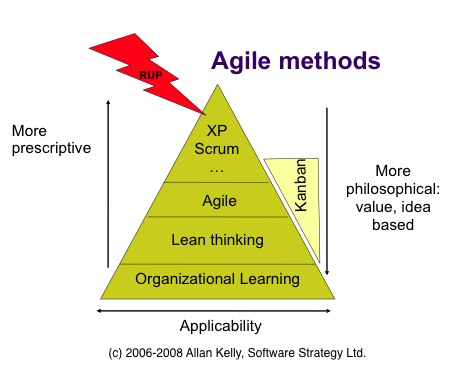
See Agile and Lean - the same but different for an explanation of the triangle.
Lets try and answer that.
When I have introduced Kanban to teams I’ve actually found it easier to get the team started on Kanban than other Agile approaches. I definately think it is easier to get started with Kanban than say Scrum.
I say this because Scrum asks you adopt Scrum perfectly before you change it. Even if you don’t adopt Scrum perfectly you need to make a lot of changes to get close to Scrum. Many teams which claim to be doing Scrum would not pass the Nokia test or any checklist of Scrum practices.
Kanban on the other hand isn’t so much a software development method but a method for process improvement. When I introduce Kanban I start by mapping out the teams process and using that to create a Kanban board. The Kanban board shows were the issues are and we work to improve them.
Why Kanban sounds so difficult is because is because people are still working out why it works, what works best and how to implement it. You need this kind of understanding to validate the approach and to apply it widely. But most people don’t. They can delve into the Kanban toolbox as and when they need to.
For example: visualizing the process on the board will help you improve flow. You don’t need to know the word flow or what’s behind it.
But, and this is the big But with Kanban, and its my big fear with it....
Kanban can be badly or poorly applied even more easily than Scrum. You do need someone on the team, or available to the team, to get the process improvement process going. It is easy to map out the board and leave it at that. Getting the process improvement bit going is the difficult bit. Whether you are doing Scrum, Kanban or anything else creating a culture of improvement is hard.
And a Kanban board shows up your problems more quickly than anything else. Which means things might look like trouble very quickly. If you don’t have someone who knows what the board is telling you, and someone who can help the team address the core problems then it can look scary.
So even more than Scrum I advise Kanban teams to have a coach. Someone who’s been there before and someone who can drive team based improvement.
Back Rob’s question. “Is Kanban Agile?”. Well hopefully I’ve explained why it is simple enough to be considered Agile so on that basis I think it is. Whether the Kanban folk want it to be considered Agile is another question. I think many of them would prefer it was considered Lean not Agile.
As I’ve said before, I consider Agile to be a form of Lean or even exactly the same (see Agile and Lean - the same but different). Kanban’s roots are more clearly in Lean than other Agile methods. I also wonder if we would have had Kanban without 10 years of learning from XP, Scrum, etc. So Kanban might be the first “post Agile” method, thats why I put it on the side of my triangle:
See Agile and Lean - the same but different for an explanation of the triangle.
Wednesday, October 14, 2009
More Business Strategy patterns for software companies
As you might guess, I’m lightly loaded this week so I’m catching up with a number of writing projects.
The latest set of patterns in my Business Strategy Patterns for Software Companies series are now online.
This set were reviewed at EuroPLoP 2009 and describe a Pattern Language for Product Distribution. The patterns are:
The latest set of patterns in my Business Strategy Patterns for Software Companies series are now online.
This set were reviewed at EuroPLoP 2009 and describe a Pattern Language for Product Distribution. The patterns are:
- Branded Shops
- Named Sales People
- Internet Store
- Independent Retail
- Local Guide
- White Label
- Wholesaler
Subscribe to:
Posts (Atom)